Showing posts with label identity. Show all posts

5/3/11

Queer Enough

(X-posted from School For Scandal)

I am queer. I am a “biological” woman who likes to fuck men.

I am genderqueer. I have a vagina and like to wear dresses.

Confused? I will try to explain, though most of the time it’s easier not to.

Invisible queerness. Invisible transgender. Passing privileges- but exactly who and what am I passing as? People tend to assume I am a lesbian by my short hair and swagger. They looked at me like I’m a dirty tissue when I say, no, I mostly sleep with men. Soiled in their eyes. Un-queered. So much for queer as an inclusive “umbrella” term.

I’ve had sex with women, and I probably will again. But it’s not lesbians that identify with, as much as I love them as friends. It’s gay men. Gay men, I understand like none other. They understand me. And I can’t help but be attracted to them, even if I don’t act on my desires. Instead, I find the men, who, like me, are queer but like to sleep with women. Men who prefer anal sex and fisting to straight intercourse, men who wear eyeliner and skirts, men who sit down to pee because they don’t give a damn about being perceived as being “manly enough.” Men who have been called “faggot” their whole lives for refusing to conform, when ironically, they love women.

And we exist, queerly heterosexual, guy dykes and girl fags in love.

I am a femme androgyne, a fagette, masculine in short hair and muscles, feminine in lipstick and heels. I am man and woman as one, and I refuse to pick a side. I love having big breasts and rocking a 10” strap on at the same time.

My man- self is a femme faggot. Johnny Weir ice dancing to Lady Gaga in roses and sequins. Oscar Wilde, a sissy genius in lavender silk with a poison pen.

My woman- self is a lusty warrior. Grace Jones in a James Bond film, power-lifting a full-grown man over her head in haute couture and heels. French novelist, burlesque dancer and body builder Colette, dressed in a 19th century men’s suit.

I am queer. I am genderqueer. I am femme.

And if you can’t wrap your brain around that, well, I wasn’t planning on sleeping with you anyway.

5/13/10

Biphobia: Real and Relevant

"...For homo and hetero define themselves as opposites, however social science instruments like the Kinsey scale and the Klein grid keep demonstrating that purity is a cultural artifact.  And identity politics as well as science has an interest in keeping them opposite.  To add "bisexuality" as a third category here is not in fact to refine the terms of analysis but instead to expose the radical limitations of rights-based arguments when linked to a concept of fixed identity." - Marjorie Garber, "Bisexuality: The Eroticism of Everyday Life"

There was a recent discussion in a friend's blog in which a lot of people understandably lambasted bisexual activist Kyle Schickner's "report" (I use this term loosely) about the lack of bi visibility at the 2010 GLAAAD awards in Los Angeles.  The article, in addition to being poorly written, had some problems, notably his description of trans folk as having "leapfrogged from the bottom rung of the queer community past bisexuals by developing a community and iconic celebrities."  The mainstream LGTBQ movement is at best dismissive of, and at worst, actively hostile and transphobic to trans people, and to set up this false dichotomy of trans versus bi (ignoring the many bi people who are trans).  This can best be described as playing the "oppression olympics," and unfortunately colored what otherwise was a very fair point: that bi visibility has been significantly reduced since the 1990s, and that this is due to many factors, the most significant of which is a lack of a cohesive, political bisexual community within the LGTBQ movement. 

But as the comments over Schickner's piece raged on, it became clear that many people who are queer or queer allies were incredibly dismissive over whether biphobia even exists, or whether bi activism is necessary or valid.  The reasoning being that if one is visibly bisexual then the only  oppression one experiences is homophobia And if one is not visibly bisexual (the assumption being that someone in a "heterosexual" pairing cannot be visibly bisexual, which is problematic in and of itself) then that person receives straight privilege, thus invalidating the concept of biphobia.

The argument goes that gay and lesbians, being part of an oppressed group, cannot have any institutional power over a privileged group - bisexuals being assumed to generally fall into the latter.  And yet when you have examples like a self-described LGTBQ sports organization actively discriminating against bi people for "not being gay enough," it makes me wonder if the traditional model of privilege becomes too simplistic when talking about issues within queer communities.  It seems that this is an area where a model based on intersectionality would be a more functional way of analyzing these issues as opposed to a black and white view of "real queer people" (i.e. queer people who are not partnered to other-sex people) versus bi people, seen as people who automatically benefit from an uncomplicated straight privilege due to the assumption that they are or will end up in opposite-sex partnerships and have no other visible markers of queerness.

Part of the problem is that I think most of us, within queer and queer ally spaces, do buy into a particular stereotype of the "typical bisexual" - a cisgendered young white woman who is partnered to a man, and either had some sexual interactions with women when she was single, or occasionally has threesomes with her man and another woman.  I admit, one of the reasons I am still wary of describing myself as bisexual despite knowing, intrinsically, that my sexual desires are very queer, is because I fit into that stereotype.  I know I have experienced very little homophobia in my life (although it would be incorrect to say I haven't experienced any) and don't anticipate facing much in the future, so taking on an oppressed identity felt like appropriating.  But how bizarre is it to define an orientation by the amount of oppression one faces as opposed to who you are?  The underlying sentiment that I see behind the stereotype of the typical bi person and the reaction to Schickner's piece is that bi people are sexual tourists, privileged people who get to flirt with a queer identity in an appropriative fashion who always have the ability to retreat into straight privilege.

This way of viewing bi identity is typical of the main issue bi people face that is actually separate from homophobia: invisibility.  Bi people who are non-gender conforming, who date primarily same-sex partners or are in a same-sex relationship often do not get read as bi at all.  So their existence as bisexuals is invalidated and shoved into the tent of "real queerness" and we're left with the most privileged bi people as the unofficial representatives for everything bi.

I recognize the problems with drawing comparisons between different kinds of oppressions and I will attempt to resist doing that here.  But "passing" is a word that is used in various communities to define how much a person is able, intentionally or unintentionally, to "hide" a socially undesirable identity from mainstream culture.  In most discussions about "passing" (and I acknowledge the word is inherently problematic for multiple reasons) the idea is that any privilege one receives from passing is a double-edged sword.  Someone can pass as something they are not and receive privileges for it, but that doesn't negate their core identity and forces them into a constant cycle of having to chose whether to continually out themselves or not.  The very stress that has to go along with having to constantly make that choice, day in and day out, is largely ignored in the context of most discussions I see about bisexuality.

This factors in with the current accepted narrative that claims that homosexuality is inherently an inborn trait, as is straightness.  What would follow from conclusion, which is simplistic but may be based in some degree of fact, is that bisexuality is similarly an inborn trait, but it isn't treated as such.  It often seems to me that the notion behind a biological root of homosexuality is the idea that no one would choose gayness if they were able to.  Bisexuals fuck up that narrative by having the ability to "choose" to live either a gay or straight lifestyle yet by the very act of acknowledging themselves as bisexual they refute and refuse the binary.  This is obviously threatening, primarily to straight people who don't want to confront the issue of sexual behavior as a choice, but also to the modern mainstream gay rights movement which depends on the idea that gay people really just can't help it - they're born that way.

How does this relate to biphobia?  One of the main reactions to someone coming out as bisexual is a "yawn" or "why does this matter?"  Those reactions are telling.  Because bis have the ability to choose, their queerness is invalided, both by straights, and yes, sometimes by gay people as well.  It's a "yawn," as in, "Why would you tell me this?  Your sexual behavior doesn't concern me.  You're really straight and looking for attention."  Or it's "Why does this matter?  What you do with your sex life is of no concern to me."  While gay people get these reactions as well, from what I've seen it's more pronounced with regards to bi folk, because their sexual orientation is conflated with their sex lives.  There was a time when gayness was reduced to same-sex acts, but mainstream gay rights organizations have gone a very good job of presenting gay people as a"just like straights" - married, picked fences, and so on.  And this works, because if we "heteroize" gay behavior to be "Just like straight people, - biological, inborn, but with the same sex instead of the opposite sex," then it's less threatening to straight people as they don't have to really question their own potential queerness.  This has been defined as "homonormativity" by Lisa Duggan.  From Wikipedia:

"According to Penny Griffin, Politics and International Relations lecturer at the University of New South Wales, homonormativity upholds neoliberalism rather than critiquing monogamy, procreation, and binary gender roles as heterosexist and racist.[30] Duggan asserts that homonormativity fragments LGBTQ communities into hierarchies of worthiness. LGBTQ people that come the closest to mimicking heteronormative standards of gender identity are deemed most worthy of receiving rights. LGBTQ individuals at the bottom of the hierarchy (transsexuals, transvestites, intersex, bisexuals, non-gender identified) are seen as an impediment to this elite class of homonormative individuals receiving their rights.[31] "

You'd think it would be a big "duh" to say that defining a queer person primarily through how they have sex is horrible, but this is the common way that bi people are spoken of on mainstream gay blogs and communities, even though this is exactly the same line of thinking that has dehumanized and sexualized gay people within straight society.  Bisexual behavior is far to often treated as a kink, or a sideline sexual interest, as opposed to being part of someone's identity.  Mainstream gay rights organizations may have been somewhat successful in desexualizing gays, but this has never happened for bis, and won't be able to happen until we move past the simplistic narrative of being "born gay" or "born straight."  The inherent radicalness of bisexuality forces everyone to confront the full spectrum of human sexuality, and for that reason it's threatening.  Bisexuality, as something that is not just a biological imperative but an active choice, resexualizes the narrative of queerness. 

As I've said before, I am not anti-identity politics.  It has been an incredibly valuable way to inspire individual and community pride, as well as an essential organizing tool for achieving tangible political gain.  But when speaking in a holistic sense about "sexual orientation" or "sexual identity" identity politics does not provide the tools to speak about someone's full experience.  A cisgendered bisexual person in a heterosexual relationship may often pass as straight, and in that sense they absolutely have privilege over many other queer people.  Yet that passing is fraught.  Bisexual people are constantly judged on the basis of their sexual and relational choices, not just by a homophobic straight society, but by the queer community that demands they prove their queerness as the price of admission.  Bisexuals are the "other" in both worlds.  Straights wonder why bisexual people would choose to be out as bisexual, when they could easily pass - as in, "Why are you wasting the straight privilege you could have?"  It seems like no one cares how bis actually experience privilege.  Tomorrowshorizion wrote about this experience on Feministing: "My experience is that being initially granted straight privilege often just makes the backlash more vehement than if we'd just be read as queer in the first place. We're not just seen as weirdos, but also as traitors once they figure it out."
 
Meanwhile, there is real emotional pain and frustration associated with the difficulty of not being accepted in the queer community while being rejected by the straight world that is ignored in the larger discussion about privilege and power.

I'm not saying we shouldn't call out bis in queer spaces when they engage in homophobia or act in privileged ways.  Of course we should, and bis, particularly those of us who benefit from striaght privilege, have a responsibility to own that and know when our voices are oppressive to other queer people.  That said, the way I see things framed in current discussions about privilege ignores the complexities of bi identity and lives. Identity politics have been very helpful, but what happens when it bumps up against individualism and shitty Internet behavior?  We get a narcissistic version of the oppression olympics in which the less privilege you have, the more you "win" - win at what, I haven't quite figured out yet.  It seems obvious that oppression isn't a zero sum game, but in many queer and feminist spaces online and in the real world, it's certainly treated as such.  Thus someone is who is bi and out becomes a target, because being bisexual, they are admitting to having access to straight privilege, and thus their experience of queerness is made irrelevant.  If that's not biphobia, what is?

4/25/10

More Biphobia News!

This has not been a good week for the bis.  Gregg Kravtiz is a young bi man in Philadelphia who is challenging incumbent Babette Josephs in a primary race for a state legislature seat.  It's not every day you see out bi people running for any kind of office, but apparently Kravtiz's sexual identity hadn't been an issue in the campaign for the 182nd district until his opponent made it one.

Josephs, who is straight but considered to be a strong supporter of LGBT rights and enjoys the endorsement of the mainstream gay organizations in her district, was caught on audiotape at a fundraiser claiming that Kravitz was actually straight, and was lying about his sexuality to get votes.

"I outed him as a straight person," Josephs said on the recording..."and now he goes around telling people, quote, 'I swing both ways.' That's quite a respectful way to talk about sexuality. This guy's a gem."

“There will be cheating if he can get away with it, because he already has tried to lie to people about a whole bunch of stuff, including his sexuality."

 Oh, those treacherous, traitorous, slippery bis!  How did Josephs know he's straight?  Apparently he has been dating a woman since January.  So once again, a bi person's identity is judged only by who they are currently sleeping with, and nothing else.


Kravtiz sent the audiotape to local newspaper The Philadelphia Inquirer.  Of Joseph's comments, he said, “That’s completely inappropriate.  The way in which my opponent mocked me is very damaging to members of the LGBT community questioning whether to come out. It sends the message that you are subjecting yourself to ridicule, even from allies.”

While the straightwashing of Kravtiz is infuriating, the response by some publications reporting on the story are downright annoying.

"We've hit a new high point when candidates are accused of pretending to be gay to win a seat," said Mark Segal, publisher of the Philadelphia Gay News and a pioneering civil rights advocate. "I've been doing this for 40 years, and I never have heard of this kind of charge in any race in the nation," he said. "I take that as flattery. It shows how far we've come."

It may be a new high point for gay and lesbian identity politics, but having gay leaders refer to Kravitz' identity being policed as "flattery" or even "humorous" is a low point for biphobia.  Other publications reporting on the story have managed to out their own ignorance, with headlines like: "PA Congressional Candidate Outed For Pretending to be Gay," and LGTB blog Qweerty closing the story with more musings about how great this inappropriate and offensive treatment of Kravitz is for "the movement":

"It would be most interesting if Kravitz were actually straight, and using a bi identity to pull in votes. But what a statement about acceptance of LGBTs that, by itself, would be making."

What a statement Qweerty is making in refusing to accept Kravtiz's identity at face value.  Comments on all articles are as predictable as they were with the Gay Softball League discrimination story, with claims that bisexuality doesn't exist, that Kravtiz is the person who made sexuality an issue here, and that it's just too "convenient" that he is currently dating a woman.   All this in a week where longtime bi activist Kyle Schniker, complaining about lack of bi visibility in an (poorly written, trans-othering) article he wrote about the recent GLADD awards, was met with hostile comments by other queers about how "bisexuality is a useless identity," and "biphobia does not exist."

Clearly, the suspended players of D2 and Kravtiz might be hard-pressed to agree at this time.


4/20/10

Calling Two Strikes On Gay Sports Organization

 For the North American Gay Amateur Athletic Alliance, a softball league that defines itself as an "organization that promotes amateur sports competition, particularly softball, for all persons regardless of age, sexual orientation or preference, with special emphasis on the participation of members of the gay, lesbian, bisexual and transgender community," one's on base percentage matters less than the side from which one bats. During the 2008 Gay Softball World Series in Seattle, WA, San Francisco-based team D2 had its eligibility challenged by another team. Subsequently, five members of the team were subjected to interrogation by the league and three of the five were found to not be gay enough to play ball. The men were asked intimate details about their sex lives in front of a panel of 25 people, most of whom were strangers.  Quoting from the National Center for Lesbian Right's press release:

"The players were forced to answer whether they were “predominantly attracted to men” or “predominantly attracted to women,” without the option of answering that they were attracted to both. After each player was interrogated, a panel voted on whether he was “gay” or “non-gay.” NAGAAA’s committee refused to entertain the idea that the players could be bisexual. In response to a player’s statement that he was attracted to both men and women, a NAGAAA member responded, “This is the Gay World Series, not the Bisexual World Series.”

Ultimately, the predominantly-white committee voted that Charles, Russ, and Apilado, all men of color, were not gay. The committee voted multiple times on at least one player. The committee also declared that the other two players, both white—one of whom had given precisely the same answers as Russ—were gay. The committee recommended disciplinary measures against Apilado, Charles, and Russ their team, and the San Francisco Gay Softball League, including forcing their team, D2, to retroactively forfeit their second-place World Series win."

There are two major issues at the core of this fight. Policing bisexual identity is deeply problematic. Is being attracted to some men enough, or should we let a cadre of gay male sports fans dictate who is or is not bisexual enough to be in their company?  The way sexual identity in this case is reduced to "gay" and "not-gay" is a clear erasure of bisexuality.  Bisexuals/pansexuals/queers are not "not-gay" but are actively queer people deserving of a voice and presence in queer spaces.  In addition, there is the problem of racial typing in regard to sexuality.  This is obviously problematic with regards to how queer men (and people) of color are marginalized and made invisible for not conforming to the mainstream (i.e. white) notion of queerness.

Can this really be a serious stand as we enter the second decade of the 21st century? That this occurred is troubling. That 25 adults sat in a room and participated in this tribunal is staggering.

The National Center for Lesbian Rights has taken this on as a legal case, but if you are still angry, feel free to e-mail each and every one of the board members to eloquently voice your disgust.

(This has been a tag-team post by the Girl and Boy)

4/9/10

We're Not The Only Ones Thinking About "Out"

I was really gratified to read this post on Feministing regarding the judgements people in general and the "blogosphere" (I really, really, really hate that word) in particular regarding celebrities who come out, citing Ricky Martin's situation in particular.

Yes, of course most people's reaction to Martin coming out was, "DUH," and I think I even said something along those lines in conversation myself.  But I thought about it some more, and two different issues came to mind:
1) In the U.S. we think of Ricky Martin as a two-hit-wonder has-been.  But he's still incredibly popular in Latin America, where the politics of him being an out gay sex symbol occur in a different cultural context than it does in the U.S.  Nobody has noted that in his self-outing blog entry, Martin first wrote it in Spanish and then in English.  I really don't think white Americans were necessarily the audience he was primarily speaking to here, yet our reactions to his self-outing act as if we were, because, well, we're white Americans - that's what we do.

2) Intersecting with my previous entry's point about Anderson Cooper, Ricky Martin wasn't closeted.  One of the realizations the Boy and I came to the other night is that "closeted" is not the opposite of "out" although people who are highly vested in the outing of public figures pretend that it is.  Being out is a public statement, but being closeted implies lying, secrecy, and shame.  Based on the quick research I did, Ricky Martin never said he wasn't gay.  If he was trying to pretend to be heterosexual, he did a bad job of convincing people, given that he decided to have children via a surrogate and was widely known to hang out around Miami with his boyfriend.  That's not a closeted life, folks.

Anyway, Lori says it right:

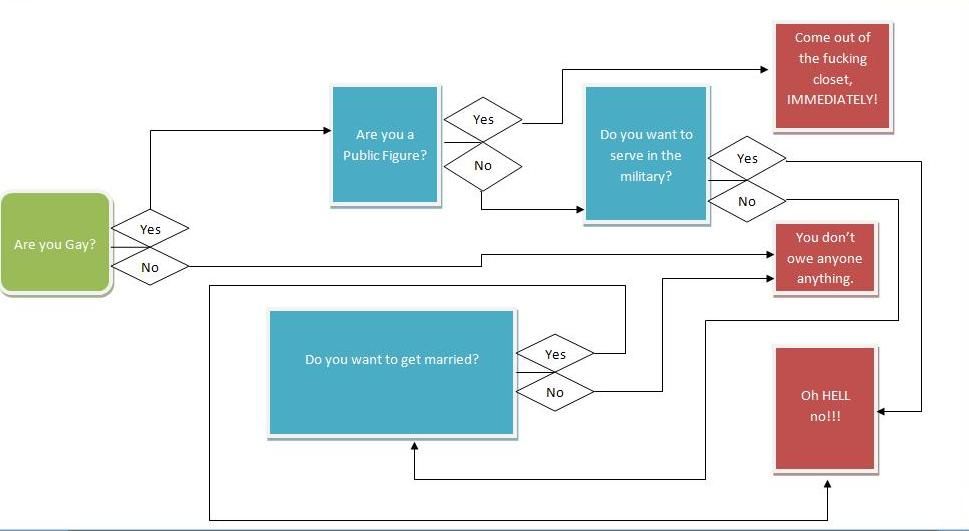
"As a bi-racial cis-gender able-bodied woman in a heterosexual relationship, I may not be able to say I know what it is that Ricky Martin went through before deciding to come out. But I can't help but be struck by the hypocrisy of an America that forbids disclosure from their armed servicepeople and demands it to the point of issuing a frenzied media mandate from everyone else. Whether the criticism was coming from other gay men and women or not, rushing to judge the timing or impact of his decision fails to acknowledge his humanity and undercuts the ownership of his decision."

Just another area where identity politics are tricky, as they intersect with the personal and the political, and above all, a largely straight populace either demands people come out, assume they're already out, or demand they stay closeted based on entirely arbitrary modifiers to the situation.  At this point, can we really blame some queer people for deciding they don't necessarily want to play that game?

4/6/10

"Post-Out" Post #1: Johnny Weir as Post-Out Poster Child

Despite our open-mindedness, there is definitely a dogma that exists as an undercurrent to almost any discussion on sexuality within progressive, queer-friendly circles.  I'll name a few: biology is destiny; identity is orientation and vice-versa; there are three distinct, non-overlapping categories of sexual orientation; female sexuality is fluid, whereas male sexuality is not; queer celebrities "owe" it to "the movement" to be out yet every out queer celebrity has been accused and will continue to be accused of using their identity for attention.

It's obvious that I don't agree with many of these "truths" -  the intersection of what we call "orientation" - assumed to be inborn (and probably is in many cases) with "identity" (a social category if there ever was one) is so complicated, yet due to the gay rights movement shaping the language of visibility, the distinction between these two separate markers and what they mean has often become blurred.  This isn't necessarily a bad thing - the gay rights movement as we know it started in a time, not all that long ago, when visibility was very low, due to culturally-enforced messages of shame and the ever-present threat of violence (which still exists today).  Having a movement that dared to state that "we're here and we're queer," was incredibly important when most same-sex behavior was conducted secretly.  And as a result, we get the concept of  being "out."

This will be the first of several posts examining the concept of being out and how it relates to identity and a changing cultural landscape.  As a disclaimer, I'd like to state that personally, neither one of us are one of those assholes who claim that identity politics are pointless or useless.  Without identity politics, we wouldn't have any of the modern liberation movements.  I think we can acknowledge identity politics as a tool that is still useful, while also critiquing what aspects are limiting or no longer applicable to everyone.  Hence: Johnny Weir.

For those of you living under a rock, Johnny Weir is a world-class figure skater and phenomenal athlete whose "flamboyant" style and "outrageous" personality get more attention than his actual performance in various competitions.  Weir is androgynous - not in the the sexless, aloof sense, but in the visceral "Mick-Jagger-and-Alan-Cumming's- lovechild-but-with-more-sequins" kind of way.  He exudes sexuality, masculinity, and yes, femininity as well.  He's not the "safe" kind of male figure skater who attempts to butch up his routines and costumes in an attempt to prove how very "not gay" figure skating is (and in the process, makes it seem perhaps even more gay - Evan Lysacek anyone?  Regardless of Lysacek's orientation, there's something  macho yet queer about his Village People style of masculine performance).

The problem, however, is that Weir is not "out" in the traditional sense.  He has never said, "I am a gay American," or "I am proud to say I am a fortunate homosexual man." 

And yet the reaction in the queer blog world is not to condemn Weir for not being out, the way recently out Ricky Martin and Sean Hayes, or not-yet-out Anderson Cooper have been condemned, but rather to celebrate his snazzy yet thoughtful statements on the media's attempts to categorize him.

In response to critics who claim he's too gay or feminine, Weir has said:

"I hope that more children have the same opportunities as me, with the same parents as me, that let me be an individual, who gave me freedom, and taught me to believe in myself before anyone else would believe in me.
I hope more young boys and girls can grow up to have that love and support from their families, and it's very clear to me that those two men talking on that program did not have that kind of upbringing."

He has also said:
"Figure skating is thought of as a female sport, something that only girly men compete in. I don't feel the need to express my sexual being because it's not part of my sport and it's private. I can sleep with whomever I choose and it doesn't affect what I'm doing on the ice, so speculation is speculation. I like nice things, and beautiful things, so if that is the only way people are determining that I swing one way or the other, then to me, that's sad. You can't judge a book by it's cover, ever. I never get angry about things because it's human nature to be jealous and rip people to shreds if you don't like them, regardless of the subject. I am who I am, and I don't need to justify anything to anyone."

There's multiple awesome examples across the Internet of Weir defending his right to be his own bad self, and plenty of examples of the media fixating on his orientation and gender presentation as well.  I haven't seen a single gay site demanding that Weir out himself, however, yet plenty of sites do the same for other rumored gay celebs.  The difference?  I suspect it has something to do with Weir's "flamboyance" and "fierceness" - that is, his lack of conformity to masculine gender norms.  The idea is, nobody who wears that much fur and poses in heels could be straight.  And it's apparently irrelevant that Anderson Cooper's reasons for not commenting on his orientation are as valid as Weir's - Cooper is gender-conforming, Weir is not.  The former is perceived as having a responsibility to out himself, the latter isn't seen as needing to, we already know - have you seen the photoshoots?  OMG!!  He wears mascara, like, ALL THE TIME!

Of course, the notion that an androgynous or feminine gender expression automatically renders a man gay is an inherently problematic one.  For all we know, Weir is bisexual, or has a serious political aversion to labels, and who knows, he could even possibly not like the cock.  It would not be the first time a flamboyant guy was into pussy. The aforementioned Jagger, Bowie, and half of my high school drama club all fit into that category.  As a woman long known for loving, in the biblical sense, men who don't conform to gender roles, I can assure you there are many flamboyant guys who dig the vag, regardless of how they identify.  The conflation of gender expression with sexual orientation and/or identity is a useless trope yet still ever-present.

I don't know Weir's motivations for not commenting on his orientation - I can only guess.  But in a world were people are still assumed to be straight unless their expression of gender deviates slightly in which case they're the gayest thing to ever have gayed, it looks like he's giving the mostly-straight sports world, as well as the media, the middle finger.  After all, they're the ones going nuts attempting to comment on his sexual orientation without the ability to actually identify him as a homo.  Weir has positioned himself to be a role model to every gender non-conforming kid out there, but actually declaring himself "out" while already being perceived as gay wouldn't benefit him, or even the queer rights movement - it would just benefit a straight society and media intent on categorizing him.  And he doesn't seem particularly interested in giving them the satisfaction.

So the question shouldn't be, "Is he?" or even necessarily, "Does it need to be said?"  but rather, "Does it matter?"  Celebs and people in general are not expected to comment on how straight they are unless they are perceived as being gay - Hugh Jackman and his famous love for musicals comes to mind, and the rumors swirl despite a decades-long marriage to a lady.  It's true that people are more likely to care about queer civil rights if they know someone who is out, but I don't think anyone can seriously argue that it matters to gay liberation if someone as non-conforming as Weir is out or not.  So does it matter when queer celebs such as Cooper, or pre-outting Rick Martin live their lives without hiding their queerness, if they're not shouting it from the rooftops?  I'm not sure, yet, but I think the more important question at this point is who, exactly, does the outing of assumed-gay or unofficially-gay celebs serve? 

More importantly, this video is basically the best thing of all time:

4/2/10

My Problems With Pansexual

The term "pansexual" is cropping up more and more, both online and off.  I've gotten in some pretty heated discussions about the term.  For those unfamiliar, the idea behind pansexual is that it defines an identity in which a person has the capacity to be attracted to all genders, or any form of gender expression.  Hey, cool.  The problem is that when questioned about it, 9 times out of 10, it seems a pansexual-identified person will define it in opposition to bisexuality, and it goes a little something like this:

"Bisexual means you're only attracted to men or women, but pansexual means you're attracted to transgendered, genderqueer, androgynous, and intersex people."

Cliche record scratch time!

There are two glaring problems with this definition of pansexuality.  The first is that it "third-genders" or "other genders" all trans people, by defining them as not men or not women, but something else - a nebulous third category.  While there are plenty of people who identify as trans who also identify as genderqueer or outside a gender binary, there are also many, many trans people who find this other-gendering to be extremely invalidating and offensive.   I've been told I'm "reading this into" pansexuality but if you do a quick Google search on pansexual definitions, defining trans people as automatically outside "man" or "woman" comes up over and over and over again.  Not cool.

The other problem is that it incorrectly defines the attractions of people who consider themselves bisexual.  For a long time, and for many to this day, "bisexual" is a sort of catch-all term that encompasses anything inbetween "straight" or "gay". It was a term created in a time where notions of genderqueerness didn't really exist, nor did people spend a lot of time differentiating between the biological concept of "sex" versus the social idea of "gender."  However, the term stuck, and became useful as both a personal and political identity.

This does not mean that all or even most people who identify as "bisexual" are invested or only believe in a gender binary or that they are only attracted to cisgendered people, and it is actually pretty fucking offensive to suggest otherwise.  Most people would agree that an acceptable modern definition of "bisexual" means "attracted to more than one gender." 

"But 'bi' is in the title!  It must mean two!" 

That's just facile, overly-literal interpretation that serves little purpose.  For the most part, the definitions of "bisexual" and "pansexual" can and are the same.  Some people choose "bisexual" because it's the word the heard first, because it's more commonly accepted than "pansexual", because they feel it already has a political or social movement behind it.  Some people choose pansexual because they feel it's more inclusive, or it better describes them, or because they want to emphasize being especially attracted to people who fall outside a gender binary.  And that's all cool.  It's not cool to pit the terms against each other in an attempt to define other people's orientation.  I'd say the same applies to "omni" or "ambi" (both less common than pansexual, but both also used). 

Identity is complicated enough without drawing artificial boundaries around "bi" because you're stuck in a binary way of thinking yourself.  Identification markers serve as shorthand and aren't always going to be able to fully encompass the complexities of a person's attractions and behavior in a single word, so why try?  Aside from the terminology, as bi/pan/omni/flexible/whatever people we have bigger fish to fry - like the assholes who say we don't exist in the first place - to spend time shitting on people who are in the same boat you are.

3/9/10

Just A Chat Post

 I've started to real blog entries but then got sidetracked talking to the BoyAboutOaktown instead.  So instead of a real post, you just get a tedious chat transcript.  Hopefully we'll get some more real content on here soon.  Enjoy my lack of punctuation and grammar!
me: i was reading these bi blogs linked to a bunch of articles from a few years ago about mcgreevy and such, and women in relationships with bi and/or gay men who are closeted. and these articles, they use bi and gay INTERCHANGABLY. it's not surprising but it's still so bizarre
it's just further proof that people see bi male as just a transitory identity on the way to full on gayness
although it was interesting that two of the blogs these bi men blogs linked to were men who had come out as bi in marrigaes and then ended up coming out as gay. it's so weird that it gets used that way
i think it has a lot to do with how we construct identity in general though.
these men behaved in what we'd term a bisexual manner for 20, 30 years in some cases
i'm not saying they can't adopt a gay identity now, but we conflate identity with orientation
if you have had a successful loving and sexual relationship with a woman for many years your orientation is probably not 100% homosexual as we think of it
 boyaboutoaktown:  True.  I think there's also a lot of pressure societally
 No, but a coming out is a coming out.  Now you're ghey.  Once you've tasted the peen.
 me:  plus there's nothing like a relationship gone sour to make you want to swear off the sex of the person you were with
 boyaboutoaktown:  Yeah, I can see the guys having an affair with some guy who's totally not their wives, and listens to their shit, and they think, "Hey, this is far better than my marriage.  I must be gay"
 me:  if your experience with women for the last 30 years was an experience with one woman that left you feeling trapped and resentful, i could see the appeal of  "YEP GAY NOW"
 boyaboutoaktown:  Wait, gays get lots of head from someone who worships my cock in the two hours each week we're together instead of reminding me about taking the kids to school.

me: plus if these marriages were sexually stiffling and these men are basically having like, a second adolesence sexually by fully embracing the sexuality thy've repressed for 30 years. it's easy to see again why that identity would be adopted. i just don't buy that these men were "secretly gay" all along. some of them maybe, but not all.
 boyaboutoaktown:  Of course I was gay, I was miserable with that woman for the last two decades.

me: i find it interesting that so many of these bi married guys end up in relationships with very sexually conservative women. did you notice that on shybiguys?
it seems to be a recurring theme. the freudian in me wonders if they were subconciously seeking out sexually conservative women to avoid having to confront their own sexual desires
 boyaboutoaktown:  Interesting.  I've never thought about it, but it does dovetail nicely with their own self-loathing. Why not get someone who resents that as much as you claim to.

 me:  yeah, idk, i may be pulling it out of my ass.
i mean there's the small subset of happily married bi men in open relationships with sexually liberal female partners who are usually bi themselves, but on the whole married bi guys seem to be in relationships in which the sex wasn't great to begin with
and quite a few of the closeted ones seem to be prone to cheating on their wives with men and women, too
 boyaboutoaktown:  I think you may be on to something.  Then again, quite a few of them describe relationships in which their partners were much more queer-friendly and then took a decidedly "no-homo" turn after kids et al
 me:  yeah that's true, a lot of women get more conservative re: sex post-marriage and kids
 boyaboutoaktown:  Does it say something that women who are more sexually liberal would go for a man who is so repressed about his identity?
 me:  quite possibly, maybe that they are attracted to an aspect of his queerness yet afraid to fully embrace that. after all what does that say about THEM. in my experience most women partnered with men, regardless of their liberalism or queer friendliness, tend to have a strong distaste for any non-gender-conforming behavior in their male partner, even while being attracted to aspects of it.
if your man has feminine traits, it's like it throws your femininity into question. and then there's the perennial fear of being a beard, which relates to percieved sexual undesirability
 boyaboutoaktown:  Though isn't there something gender-conforming, oddly, in wanting to see your man fuck and dominate another man?
 me:  i think so, a guy who is a top is still maintaining some degree of a masculine gender role
but then again, how many bi men in het relationships are tops? have we ever come across any?
 boyaboutoaktown:  Right.  He's dominating another man in the most extreme way possible

 me:  it seems like the majority of bi men in serious relationships with women are bottoms or maybe vers with a tend towards bottoming.  well we've talked before about how maybe so many 'straight-ish' bi men tend towards submission b/c in their heterosexual lives they are expected to be dominant by default.  men don't get to express submissive desires much because it's seen as feminine
 boyaboutoaktown:  True.  I think that comes up again and again on shy bi guys.

 me:  to the point where maybe some of these straight identified guys engaging in bi sex might really be more straight than bi, but just really submissive, and in our culture women dominanting men isn't taken seriously
because only a man can truly dominate, y'know?
 boyaboutoaktown:  These guys feel freed by the fantasy of being submissive. Hence much of the cock worship.  They want to be taken. Being submissive to a woman is verboten, but being sub to a man, well, you've already crossed the homo line.
 me:  i think it's deeper than that, like, a domme woman is almost a form of drag. it's not taken seriously, it's just a costume, almost a joke.  there isn't a real threat.

 boyaboutoaktown:  I think it is play acting to an extent
 me:  right, whereas when a man in dominant it can be play but there's an undercurrent of reality
 boyaboutoaktown:  But I think it's also about being able to express tenderness and vulnerability in a way that society frowns upon.


3/3/10

Cookware and Ambidexerity

First off, it didn't turn out to be a twink I spent the night with. The twink and self-described former fratboy stood me up. Instead I ended up with a guy, who while sweet and a good lay, spoke exactly like Wallace Shawn. Luckily, he didn't speak during sex. Otherwise, I couldn't have helped myself from blurting, “Anybody want a penis?”

Back to the point, as I assure you I have one. Bisexuality was gaining ground in the 1970s, 80s and 90s as a real identity. Somewhere along the line, people looked at the flawed label and pointed out that it really didn't encompass the spectrum of human desire, as if that failing was unique to the bisexual label. Thus we got self-described pansexuals, ambisexuals, pomosexuals, polysexuals, sapiosexuals, etc. The most often cited reason was that these people could love and date people who were transgendered, intersex, or in some way gender queer.

While I don't want to shit on inclusiveness, I find the reasoning to contain an element of exclusiveness and othering, in addition to a dose of third-gendering. Yes, the prefix bi does mean two. That's a language issue, not an issue residing with the people taking the label. When one says, “I'm pan because I'd sleep with/date/love a transgendered person, one is implying that other, non-pansexual people would never get involved. It's also making transfolk to be some weird other. Many transfolks identify as having a specific gender identity. If you're a person assigned male gender at birth and now live and thrive as a woman, then why should you feel flattered by having someone effectively say, “I could love you, not because I am attracted to women, but because I can see past what other people of your desired gender cannot”?

Finally, there's an element of terribly misplaced elitism in these labels. Lord knows, many bisexuals have been guilty of sitting on the “I see people, not genders” horse. That trope needs to be retired. So do labels such as sapiosexual. So you only screw the thinking? How deep you are. You'd pass on a hot piece of (non-gender specific) ass if the person doesn't share you're nuanced understanding of Heinlein's science fiction? Geek, please. Ambisexual is just as useless. It implies the same duality as bisexual, but also sounds like you can do your one-handed typing with either hand. And pansexual. Whenever I hear it, I think of my unhealthy obsession with Creuset cookware. It's also the most othering of the lot, if only by virtue of being the most popular.

As my old drill instructor used to say, “Suck it up, snowflake!”
And with that, I'm off to go watch a “My Dinner With Andre” and “Princess Bride” double feature.

Identity: What Is It Good For? Something, Maybe?

I guess it's fitting that I start this blog off with a navel-gazing look at identity - both my own, and the concept.  I'm not trying to write a thesis here (besides, others have done a far better job examining what, exactly, sexual orientation and gender identity entails than I ever could) but rather to provide a general introduction to who we are, why we decided to start this blog, and other useless nonsense.

In my previous life, when I played for the little leagues (i.e. LiveJournal, home primarily to angsty 17 year-olds and bored stay-at-home-moms taking a break from playing WoW) I frequently got into arguments about things that interested and mattered to me, regarding GLTBQ rights, feminism, polyamory, and identity.  The problem was that while doing so I identified myself as being a straight, cisgendered woman in a monogamous relationship with a guy.  What's the problem with that?  In a LiveJournal identity politics debate, plenty, but the main problem for me was that it wasn't entirely true.  But, lacking the vocabulary (or perhaps, the courage) to speak honestly about the very excruciatingly personal issues that lead me to self-identify as the tripple-whammy of straight, cisgendered, and monogamous in the rough-and-tumble world of a semi-notorious LiveJournal D-lister in which statements of sincerity are the fastest way to lose the game, that identity served its function for a time.

Let's break it down, then, with a serious commitment to honesty and pretending that anybody cares about my narcissism.  Straight?  In terms of who I've actually had sex with so far, absolutely.  If we're going to define orientation based on behavior.  Fact is, I used to identify as bisexual (and for a brief moment, pansexual, before I developed a distaste for the term) but gave it up, because I'd never gone past second base with a girl, and felt like I was one of the legion of young women appropriating a queer identity without ever having faced any sort of oppression as a result of my queerness.  I felt like I was claiming a label without having "done the time" as it were.  So despite my confused and complicated sexual yearnings, I made the decision about five years ago or so to just identify myself as straight.  After all, I was in a monogamous, heterosexual relationship that I intended to be in for the rest of my life, so since I didn't see any future opportunities to prove my queerness to myself or anyone else, I decided to take the political high road: I'd identify myself as a breeder, and take one for the team. None of that trendy bisexuality stuff for me, thanks!  I'd have to be satisfied with my attempts to be a queer uber-ally, because if I present as straight and normative, that's what I am, right?

What I didn't realize at the time was that I'd just basically put myself in some sort of weird, mixed-up identity-politics/radical theory closet out of guilt regarding my own privilege.  Don't get me wrong, I'm not saying that I suffered for my own mislabeling,far from it.  But I wasn't being entirely honest with others and in the long run, with myself, either.

This would be the point at which it would be appropriate, perhaps, to have my co-author and fiancĂ© weigh in with his own clumsy paragraph about his identity.  Which he would, except he's out having what I can only imagine is incredibly amazing sex with some cute twink while I'm stuck at home with a terrible head cold, getting a nice buzz on from this mimosa.  Hey, vitamin C is very necessary when overcoming illness!  Anyway, I suspect that answers at least a couple basic questions regarding his identity and our current monogamous status.

Anyway, the point of this isn't to be all, "Blah blah I'm confused about what makes me hot despite being 30 and how pathetic is that, but validate me regardess," but just to give a context for how I personally relate to the identity issue, which overall I think is the most misunderstood and radically changing aspect of sexual politics today.

Outside of the magical Internet anti-kriyarchy blogowhatsnot most people automatically identify themselves as straight or heterosexual, when they bother to think of it, and the majority of everyone else identifies as gay, lesbian, or bisexual.  What we fail to realize is that the very notion of an identity based on sexual orientation is entirely a modern one, and how we identify ourselves and others with regards to orientation and gender has been in a constant state of flux ever since.  Pandora's box is wide open, as evidenced by a lot of the lesser-known orientations flying around as well: not just asexual, but say, panromantic asexual.  Sapiosexual. (Look that one up.  Please.) And so forth. 

Fine, so there's a lot of wacky terms to describe something complex like orientational identity, no need to stop the presses, right?  But the thing with identity is that once you start to think about it, you can't have a conversation about sexual politics without dozens of unsaid assumptions about what identity is and what it means coming into play.

In the conversation that lead to the start of this blog, my co-author and I were talking over tasty burgers and beer at Barney's on Piedmont.  He was raging on about the relatively new concept gaining significant pop culture momentum of women having inherently fluid sexual orientation, with the mostly unspoken corollary that men have inherently static sexual orientation, as exemplified in Lisa M. Diamond's "Sexual Fluidity: Understanding Women's Desires."  In laymen's terms, women are inherently bisexual, and we shift throughout our lives through periods of being, whereas men are born straight, or gay, with little inbetween, save for those annoying bisexual men who persistently refuse to have their identity invalidated. 

Of course, one can't even start to have a basic conversation about whether or not womens' sexual orientation is fluid and mens' static without engaging with the very concept of what identity is and how it is defined.  Diamond seems to be, despite some claims to the contrary, an essentialist - a loaded term if there ever was one.  Essentalism refers to different things in different contexts, but with regards to sexual orientation, it does refer to the belief in some sort of inborn, inherent preference with regards to sex partners.  This is, essentially the mainstream view: people are "born" gay or straight.  We like to pretend this view is rooted in science, but it's far more political, borne out of anti-gay movements that claimed that gay identity was a chosen behavior, and thus could be stopped, usually through a liberal dash of Jesus and prayer.  The early LGTBQ (back then, just "gay") rights movement was based in a purely reactionary stance: if they say we can choose to be gay, we will say you can't! Sexual orientation is inherent.  We're born this way, so you have to accept us.  The problem is, in the real world, we all have anecdotal and perhaps even personal evidence that sexual identity, if not orientation, can be fluid.  Hence Diamond and her thesis.  Part of the problem, for Diamond, myself, and many people out there, I suspect, is conflating "orientation" with "identity" to begin with.

In his brilliant post "Respecting Sexual Identities" (linked twice now, it's that awesome), Pepomint writes:
"Identity functions as a kind of personal strategy. This is most obvious in the social arena, where a person considers their position and weighs how to describe themselves. Identities tend not to match perfectly, so expressing a sexual identity often is an exercise in compromises. For example, say a man only falls in love with men, but has good sex with women on occasion. Should he identify as gay, bisexual, or queer? If he identifies as queer, will everyone just assume he is gay? If he identifies as gay, will women assume he does not want to have sex with them? If he identifies as bisexual, will everyone assume that he is mostly straight but does men on the side occasionally?"

He goes on to talk about how identity is personal, political, and full of strategery.  So is it really surprising that something this complex could be ever-shifting?  At this point, I see identity politics primarily valuable as an organizational tool, and a way to frame a conversation.  In terms of describing what burns in a person's hearts, or loins for that matter, it tends to be woefully insufficient, regardless of how many new terms we make up.

Between mouthfuls of sweet potato fries and gulps of Sierra Nevada Ale, I suggested that because we have frustratingly common conversations like this on a daily basis that we do what any good egotistic Americans should and commit said thoughts and discussions to the public realm vis-a-vis this much-touted blogosphere.  Plus, I really just wanted to get away from LiveJournal.  So here we are.